Mud, Memory, and Meaning: The Slovak Pottery Revival Happening in Trnava's Backstreet Studios
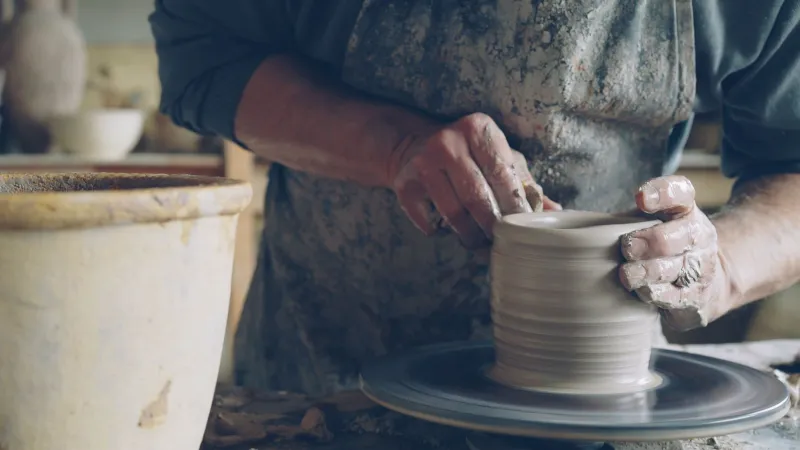
There's a particular kind of silence inside a working pottery studio. Not the dead quiet of an empty room, but something more alive — the soft thud of clay hitting a wheel, the occasional scrape of a wooden tool, the low hum of someone lost in concentration. Step into one of Trnava's growing number of ceramic workshops and that's exactly what greets you. No neon signs, no Instagram pop-up aesthetics. Just clay, hands, and an almost stubborn commitment to doing things the slow way.
For a city already punching above its weight in food, music, and street art, Trnava's ceramic scene might be its most quietly radical act yet.
Where Ancient Craft Meets a New Generation
Slovak pottery has roots that stretch back centuries, shaped by regional traditions that varied village by village — specific glazing techniques in the west, distinctive painted motifs in the east, earthenware styles tied to local clay deposits that no factory could ever quite replicate. For decades, much of that knowledge sat on the edge of disappearing, passed down through fewer and fewer hands as industrial production made handmade ceramics feel like a quaint relic.
But something shifted. Quietly, without a press release or a government arts initiative to take credit for it, a new wave of makers started showing up in Trnava — some born here, some drawn from Bratislava or further afield, a few who discovered ceramics after entirely different careers. What they share is an obsession with the old ways, combined with a very modern sensibility about what pottery can look like and who it's for.
Martina, who runs a small studio near the old city walls and asked that her last name not be used, describes her own path as "basically accidental." She trained as a graphic designer, burned out in her early thirties, and stumbled into a weekend pottery workshop almost as a joke. "I thought it would be relaxing," she laughs. "It was the hardest thing I'd ever done. I was completely hooked."
That was six years ago. Today, her studio produces small-batch tableware and sculptural pieces that pull directly from traditional Slovak folk motifs — stylized flowers, geometric borders, the deep cobalt and terracotta palette of western Slovak craft — but reinterpreted in forms that wouldn't look out of place in a Brooklyn design shop.
The Practice Itself: Why Hand-Throwing Changes Everything
Ask any of Trnava's ceramic artists why they insist on hand-throwing rather than slip-casting or working with molds, and you'll get variations of the same answer: the imperfection is the point.
Machine-produced ceramics are uniform. They're efficient. They're also, as Jakub — one of the city's most technically precise throwers — puts it, "completely dead on the table." When you eat off a hand-thrown bowl, you feel the slight asymmetry under your fingers. You notice where the maker's thumb pressed a little deeper. The object carries a kind of physical memory of the person who made it, and that, he argues, is what makes it worth owning.
The traditional Slovak techniques these artists are reviving go beyond just wheel work. Several studios in Trnava have invested serious time in researching historical glazing recipes — some involving wood ash, iron-rich local clays, or mineral compounds that produce colors no commercial glaze can match. The results can be unpredictable in the best possible way: a mug that comes out of the kiln slightly different every time, a glaze that breaks into unexpected blues along the rim.
For American visitors used to the polished consistency of mass retail, this variability is often the first thing that stops them cold. "People pick up a piece and just hold it," Martina says. "You can see them trying to figure out why it feels different. That's the moment I love."
Building a Global Following from a City Nobody Googles
Here's the part that surprises most people: several of Trnava's ceramic artists are shipping work internationally, fielding orders from collectors in the US, Japan, and across Western Europe — all without the benefit of being based in a city that shows up on most craft tourism maps.
Social media is part of the story, obviously. Short process videos of clay being centered on the wheel, the hypnotic reveal of a glaze after firing, the tactile close-ups of finished surfaces — this content travels well, and it's found audiences far beyond Slovakia. But the artists themselves are careful not to overstate it. "The internet helps people find you," says Jakub. "But they keep coming back because the work is honest."
Trnava's annual craft markets have also played a role, drawing visitors who initially come for the city's famous baroque architecture or its food scene and stumble into ceramics almost by accident. A number of studios now offer short workshops — half-day sessions where visitors can try their hand at the wheel — and these have become a genuine draw, particularly for American and German tourists looking for something more participatory than another museum tour.
Why Trnava? Why Now?
It's worth asking why this particular city became a quiet hub for this kind of revival. Part of the answer is practical: studio space in Trnava is still affordable compared to Bratislava, which is close enough for day trips but expensive enough to push creative people outward. The old city's dense medieval streetscape also creates a kind of atmosphere that makers seem to find genuinely inspiring — there's something about working in a city this old, with this much visible history, that makes crafting things by hand feel less eccentric and more essential.
But there's also something cultural happening. Slovakia, like much of Central Europe, is in the middle of a complicated reckoning with its own identity — what to keep, what to reinvent, what to let go. For the ceramic artists of Trnava, that question has a very concrete answer: you pick up the old tools, you learn what the grandmothers knew, and then you make something new with it.
That's not nostalgia. That's craft as a living conversation with history.
How to Find It
If you're planning a trip to Trnava — and honestly, you should be — the ceramic studios aren't hard to find if you know to look. Several operate out of the streets just inside and outside the old city walls, with small signs or open doors that invite you to wander in. The Saturday morning market near the main square often features local ceramics alongside food vendors. And a quick search online will turn up the handful of studios offering visitor workshops, which book up faster than you'd expect.
Just don't go in a hurry. This is the kind of art that asks you to slow down, to hold things in your hands, to sit with the weight of something made carefully. In a world that rarely asks that of us anymore, that's worth a detour.