Click, Clack, Resist: Meet the Slovak Repairman Keeping Typewriters Alive in a World That Forgot Them

The smell hits you first. Machine oil, old rubber, and something faintly metallic — like a hardware store and a library had a very specific baby. Step through the low wooden door of Jozef Krčmár's workshop on a side street near Trnava's old city center, and you've stepped into a timeline that stubbornly refused to update itself.
On the workbench: a 1963 Consul 232, its carriage return jammed, its ribbon dry as chalk. Beside it, a German Olympia SM4 waiting for a new set of typebars. And in the corner, stacked like geological strata, a tower of machines in various states of resurrection — Remingtons, Underwoods, a battered Robotron from the communist era that somehow still has a sense of dignity about it.
Jozef, 61, has been repairing typewriters in this city since before the internet existed. He's been doing it after the internet existed, too. That's kind of the whole point.
The Last Man Standing
"People ask me when I'm going to retire," he says, not looking up from the Consul's innards. "I ask them: retire to what? To sit in front of a screen? I have enough of screens."
He might be the last dedicated typewriter repair technician operating in Central Europe. That's not a verified Guinness record — just something customers and local historians say with a mix of awe and mild concern. Jozef doesn't particularly care about the title. He cares about the machines.
He learned the trade from his father, who learned it from a colleague in Bratislava back when typewriter repair was a legitimate, respectable profession with trade schools and certification exams. By the early 2000s, most of his colleagues had retrained, retired, or pivoted to printer cartridges. Jozef stayed put.
"Every machine has a personality," he explains, holding up a small spring no larger than a fingernail. "You cannot just replace parts and expect it to work the same. You have to understand what the machine wants."
It's the kind of thing that sounds eccentric until you watch him work. Then it sounds obvious.
Why Trnava, of All Places?
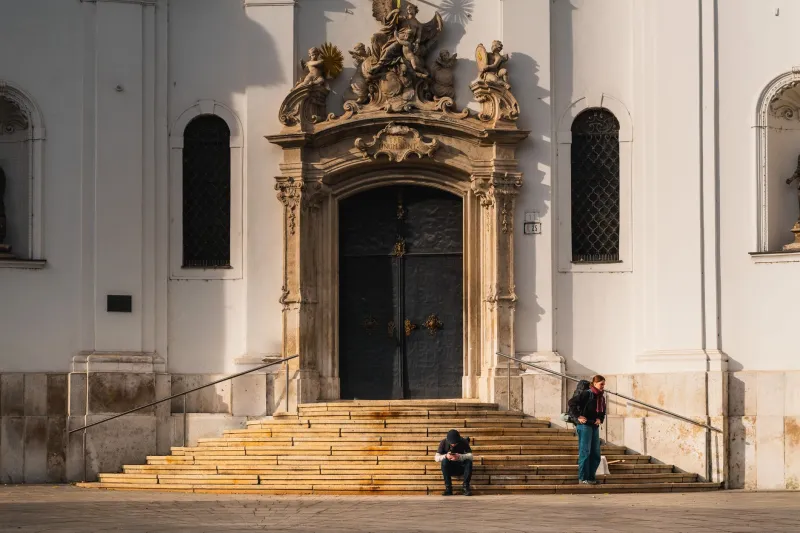
There's something fitting about this craft surviving here. Trnava has always been a city that does things slightly differently — it's got more baroque churches per square kilometer than almost anywhere in Slovakia, a university that predates the United States by over a century, and a local culture that tends to view trend-chasing with polite suspicion.
The city's slower pace, its compact walkability, its deep roots in craft and ecclesiastical tradition — none of that is accidental. Trnava has historically been a place where things persist. Where the old and the new coexist without one demanding the other's erasure.
A typewriter repair shop, then, doesn't feel like an anomaly here. It feels like a natural consequence of the place.
The Customers Are Changing
What has changed, Jozef admits, is who's walking through his door.
For years, his regulars were elderly — retired teachers, former secretaries, people who'd owned the same machine since the 1970s and couldn't imagine replacing it. They came in for maintenance, for new ribbons, for the occasional mechanical fix. They were loyal, predictable, and slowly aging out of the customer base.
Then, around 2018 or 2019, something shifted.
"Young people started coming," he says, and there's genuine puzzlement in his voice, though not displeasure. "Students. Writers. Some of them — I don't know how they found me. The internet, I suppose. Which is funny."
Among his newer regulars is Monika, a 29-year-old graphic designer who bought a 1970s Erika from Jozef two years ago and now brings it in for tune-ups every few months. "I write my journal on it," she says. "My whole life is on a screen. When I write on the typewriter, it feels like it actually happened. Like it's real."
That sentiment — the realness of analog — comes up again and again.
An American Obsession Finds a Slovak Address
If you've spent any time in Brooklyn coffee shops or Portland co-working spaces in the last few years, you've probably noticed the typewriter renaissance happening among American creatives. Writers fed up with notification pings and browser rabbit holes have been reaching for mechanical keyboards and, increasingly, actual typewriters as distraction-free writing tools. The "analog productivity" movement has its own Reddit communities, YouTube channels, and a cottage industry of restored machines selling for hundreds of dollars on Etsy.
Jozef has started receiving emails from abroad. Germany, the Netherlands, and yes — a handful from the United States.
"One man from California sent me a Hermes 3000 in a wooden crate," he recalls with a laugh. "Shipping cost more than the repair. But he wanted it done right."
The Hermes 3000, for the uninitiated, is something of a holy grail among typewriter enthusiasts — a Swiss-made machine from the 1960s with a typing action so smooth it borders on luxurious. That someone would ship one across the Atlantic to a workshop in a mid-sized Slovak city says something both about the machine and about Jozef's quietly growing reputation.
For American travelers making their way through Central Europe — and more are discovering Trnava as a refreshingly un-touristy alternative to Prague or Vienna — the workshop has become an unlikely stop. Not to get anything repaired, necessarily, but just to see it. To stand in a room where someone is still doing something ancient and skilled with their hands.
What the Machines Teach
Spend an hour with Jozef and you start to understand the typewriter not just as a tool but as a philosophy. Every keystroke is committed. There's no backspace that erases cleanly, no undo button, no cloud autosave. You write a sentence and it exists. You have to mean it.
"A typewriter forces honesty," Jozef says, finally setting down the Consul and leaning back in his chair. "You cannot hide behind editing forever. You have to decide what you think."
It's a line that could come from a productivity guru's TED Talk, but coming from a 61-year-old man in an oil-stained apron in a Trnava backstreet, it lands differently. Heavier. More earned.
He doesn't have a website. He doesn't take online bookings. You find him the way people used to find things — by asking around, by wandering, by luck.
Which, in its own way, is the most Trnava thing about him.
Jozef's workshop is located near the historic center of Trnava. The best way to find it is to ask a local — which, honestly, is the best way to find most good things in this city.