Less Is More, Apparently: The Young Composers Stripping Trnava's Concert Halls Down to the Bone
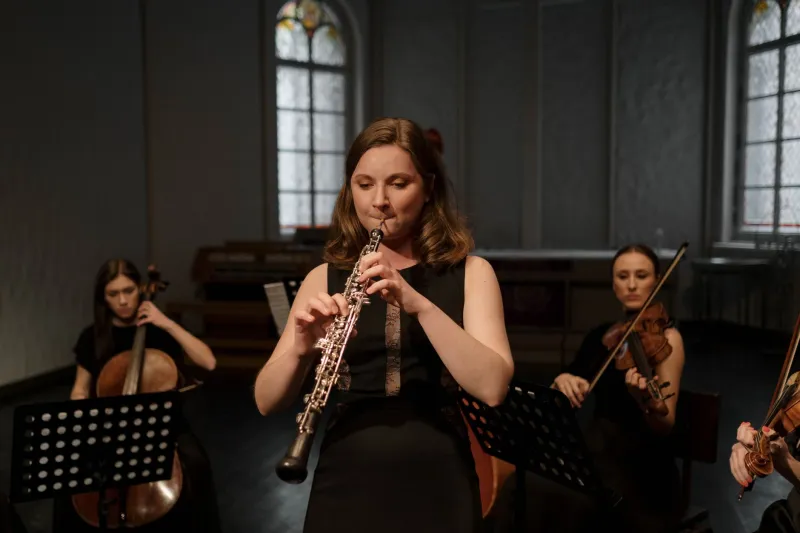
The concert lasted forty-three minutes. There were four musicians on stage. The program notes ran to a single paragraph. When it ended, the audience of maybe sixty people sat in silence for what felt like a very long time before anyone started clapping — not because they were confused, but because breaking the quiet felt almost rude.
This was a performance by Ensemble Ticho, a Trnava-based chamber group that has spent the last several years doing something that sounds counterintuitive in an era of maximalist entertainment: they've been systematically removing things. Ornamentation. Volume. Conventional structure. Sometimes melody itself. What remains, they argue, is the part that actually matters.
"There's a kind of honesty in reduction," says Tomáš Blaho, the ensemble's founder and a composer whose work sits somewhere in the contested territory between contemporary classical and avant-garde. "When you take away everything that isn't necessary, what's left is either nothing or something true. We're trying to find out which one it is."
A Different Kind of Concert
The classical music scene in a mid-sized Slovak city might not seem like fertile ground for artistic revolution. Trnava has a long musical history — the city's Jesuit university had a strong musical culture as far back as the 17th century — and its concert life today reflects that tradition: an established philharmonic, a music school, regular performances in its beautiful Baroque venues. None of that is going anywhere.
But alongside the established program, something quieter has been developing. Small ensembles performing in unusual spaces. Composers presenting work that challenges audiences to engage differently — more slowly, more attentively, with less expectation of being swept away. The movement doesn't have a name or a manifesto. It has, if anything, a shared aesthetic instinct: that the contemporary world is so saturated with noise and spectacle that silence itself has become a radical act.
Viola player Katarína Mináčová, who performs with both the city's philharmonic and several of the smaller experimental ensembles, describes the shift in terms of what audiences seem to need. "People come to a big orchestral concert and they experience something wonderful," she says. "But sometimes I think they leave feeling full in a way that's almost passive. Like they've been given a meal and eaten it. The smaller, quieter performances ask them to do more of the work. Some people find that uncomfortable. Others find it more satisfying than anything they've heard in years."
The Composers Behind the Quiet
Trnava's minimalist turn isn't a single movement so much as a convergence of individual artists arriving at similar conclusions from different directions. Tomáš Blaho came to reduction through frustration with his own early work — pieces he describes as "decorated in ways that were hiding the fact that I didn't fully trust the core idea." Stripping the decoration away was initially an act of self-criticism that became a compositional philosophy.
Elena Ďurovičová, a younger composer who studied in Vienna before returning to Trnava, came to minimalism through a different route — an immersion in the work of composers like Arvo Pärt, Morton Feldman, and Galina Ustvolskaya, figures who found extraordinary emotional depth in extreme restraint. Her recent piece Stena ("Wall") consists of a single sustained chord played by a string quartet, modulated so slowly and subtly over twenty-two minutes that listeners often can't identify the exact moment it changes. "It's about learning to pay a different kind of attention," she says. "Most of us have forgotten how."
For American audiences unfamiliar with this tradition, the closest reference points might be the works of Philip Glass or John Adams — composers who found that repetition and reduction could carry weight that conventional complexity sometimes can't. But Trnava's composers are working from a distinctly Central European sensibility, one shaped by post-communist introspection, Catholic spiritual aesthetics, and a particular relationship with history and silence that doesn't have a direct American equivalent.
Intimate Spaces, Larger Questions
Part of what makes Trnava an interesting place for this kind of work is the city itself. The Baroque architecture that defines the historic center — all those stone churches, vaulted halls, and monastery courtyards — creates acoustic environments that reward restraint. A single sustained note in a 17th-century chapel reverberates in ways that no concert hall can replicate. The space becomes part of the composition.
Ensemble Ticho has increasingly moved its performances out of conventional venues and into these older spaces. A recent concert took place in a monastery library after dark, the musicians positioned among the shelves, the audience seated on simple wooden chairs. The program included two short pieces by Blaho, a new work by Ďurovičová, and a piece by a 17th-century Slovak composer rarely performed today. The juxtaposition was deliberate.
"There's a conversation happening between that older music and what we're writing now," Blaho says. "Both are trying to say something essential with limited means. The centuries in between got very loud for a while. Maybe we're finding our way back to something."
The Audience Question
The honest question about any experimental artistic movement is whether it's actually reaching people or speaking primarily to other artists. Trnava's minimalist musicians are thoughtful about this tension.
Katarína Mináčová acknowledges that the audiences for the smaller, more experimental performances skew young and arts-adjacent — university students, visual artists, people who are already comfortable with challenging work. Breaking out of that circle is harder. "We don't want to be a closed conversation," she says. "That would defeat the purpose."
Some of the most promising signs have come from unexpected directions. A performance last spring that was open to secondary school students produced a response that surprised everyone involved — teenagers who had never attended a classical concert sitting through forty minutes of near-silence and then asking, with genuine curiosity, questions about how the music was made and what it was trying to say. "Those conversations were more interesting than almost any I've had with adult audiences," Blaho admits.
Why It Matters Beyond Trnava
The minimalist wave moving through Trnava's classical scene is part of a broader European artistic reckoning with the culture of spectacle — a growing sense that bigger, louder, and more technically impressive isn't automatically more meaningful. In a media environment defined by stimulation and constant novelty, the deliberate choice to slow down and strip back carries genuine cultural weight.
For visitors to Trnava — and the city is increasingly on the radar of culturally curious American travelers — stumbling into one of these intimate performances can be a genuinely disorienting experience in the best possible sense. You came expecting something historical and charming. You found something alive and strange and quietly urgent.
That, perhaps, is the most radical thing about it.